
We will give you the answer that costs us work, because it is the honest one: a lot of teams should build their AI and cloud projects in-house. If you have the right people and the time, that is usually the better long-term call. Outside help is for when one of those two things is missing.
This is an awkward thing for an engineering partner to write. But pretending every company needs us would waste your time and ours, and the projects that go badly are almost always the ones that started with the wrong decision about who should do the work. So here is how we think you should decide, even if the answer is “not us.”
It comes down to two questions.
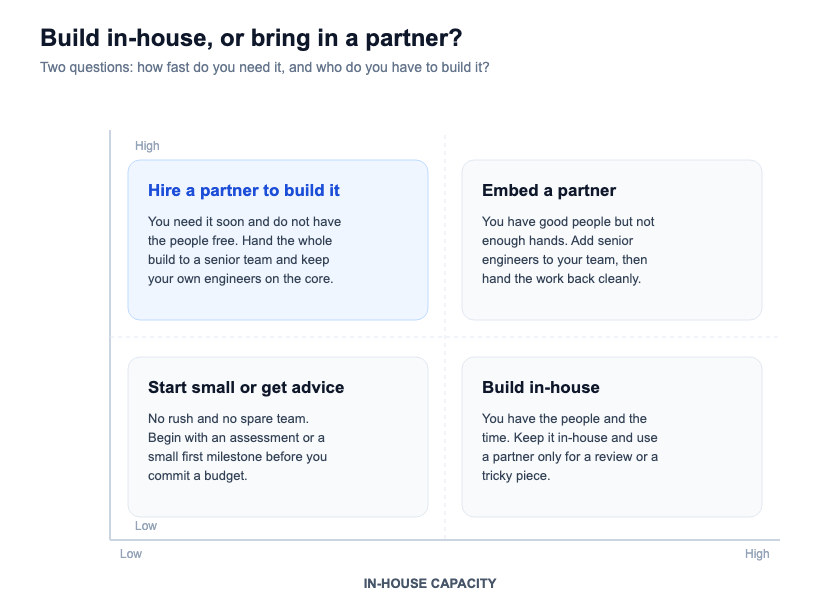
Question one: how soon do you actually need it?
Be honest here, because “urgent” gets thrown around loosely. There is a real difference between “this unblocks revenue next quarter” and “it would be nice to have eventually.” Genuine urgency changes the math. Waiting to hire and onboard a full-time engineer can take three to six months, and if the thing needs to exist before then, hiring is not really an option for this project even if it is the right long-term move.
Question two: who do you have to build it?
Not how many engineers you have. Who is actually free, and do they know this kind of work. A strong backend team is not automatically a strong fit for shipping a production AI feature or running a Kubernetes migration. Those need specific experience, and the cost of learning it on a deadline is usually higher than it looks.
Put those two questions on a grid and you get four situations.
You need it soon and your team is full
This is the clearest case for handing a build to a partner. The work matters, it cannot wait for a hire, and your own engineers are busy with the core product. Bringing in a senior team that has shipped this kind of thing before gets it done without pulling your people off what only they can do.
The thing to insist on is a clean handover. The work should arrive documented and readable, in your repo, so you are not dependent on the partner forever. A good partner is trying to make themselves unnecessary, not to embed permanently.
You need it soon and have good people, just not enough hands
Here the answer is usually to embed rather than outsource. You do not need someone to take the whole thing away. You need extra senior capacity working alongside your team, in your codebase, with knowledge transferring as they go. When the crunch passes, they hand it back and step out.
This works well when your team is good but stretched, which is most growing companies most of the time.
No rush, and no spare team
When nothing is on fire and nobody is free, the worst move is to commit a big budget to a build you have not validated. Start small instead. An assessment that tells you what the work actually involves, or a tightly scoped first milestone that proves the idea before you pour money into it. We do plenty of these short engagements, and a fair number end with us telling the client they can take it from here. That is a good outcome.
You have the people and the time
Build it in-house. Really. Your own team will understand the system better than any outsider, and that understanding compounds over years. The most a partner should do in this situation is a review at a key decision, or a hand with one genuinely tricky piece. Do not outsource work your team is well placed to own.
The honest summary
Most of the value in this decision is avoiding the expensive mistakes: hiring for an urgent project that cannot wait for hiring, or outsourcing work your team should have kept and learned from. Get the two questions right and the rest tends to follow.
If you have read this far and landed in one of the two boxes on the left, that is the conversation we are good at. You can see how we work on the services pages, and if it would help to talk it through honestly, including whether you need us at all, book a scoping call.